Portfolio Case Study
Destination Performance & Tourism Growth Dashboard
This showcase combines official Singapore tourism and hotel datasets with a transparent synthetic destination operating layer to show how a destination operator can connect visitorship trends, destination value, campaign ROAS and guest experience in one management view.
Executive Narrative for SDC
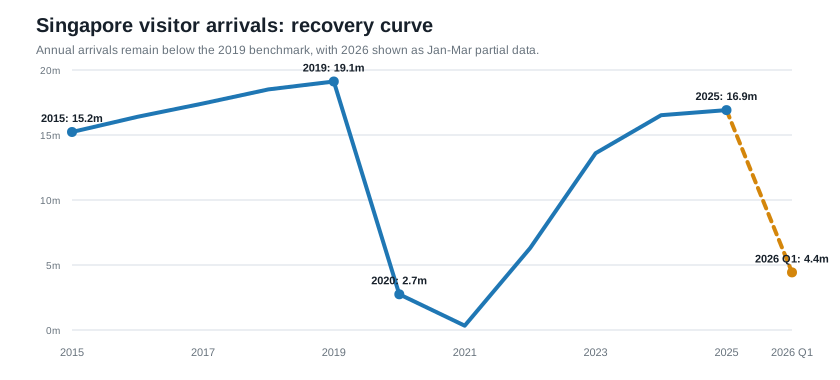
- Singapore recorded 16.9m international visitor arrivals in 2025, reaching 88% of the 2019 baseline.
- Jan-Mar 2026 arrivals reached 94% of the same 2019 period, suggesting demand has broadly normalized but remains uneven by market.
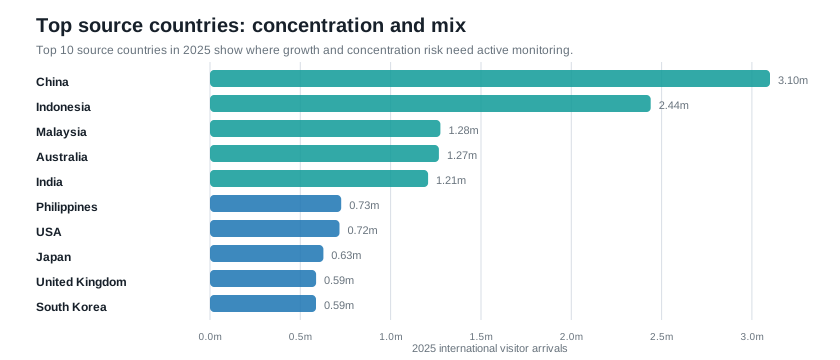
- The top five 2025 source countries account for 55% of arrivals, making source-country concentration an important management lens.
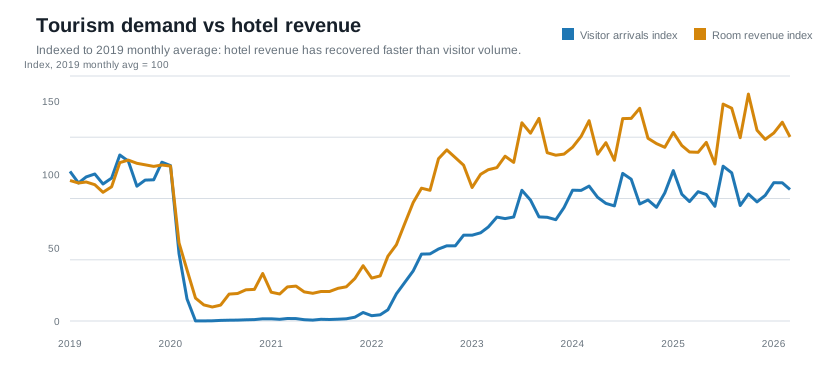
- Hotel room revenue in 2025 reached 128% of 2019, indicating yield recovery has outpaced pure visitor-volume recovery.
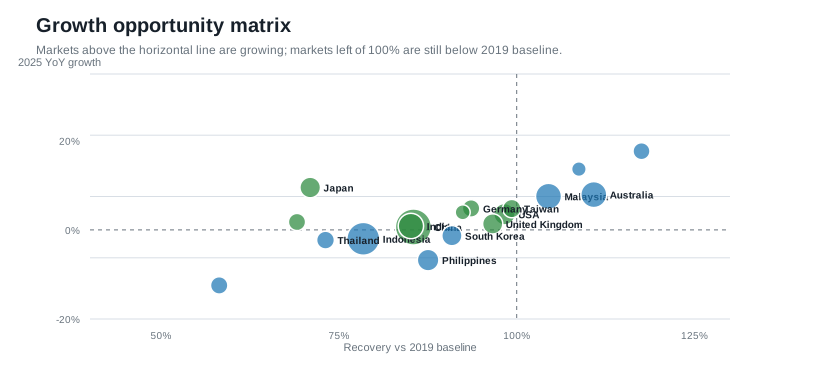
- Opportunity screening highlights Japan, Germany, Taiwan as markets worth deeper campaign and partnership review.
- The synthetic destination layer shows how management could connect public demand signals to revenue per visitor, campaign ROAS and guest experience monitoring.
Step 1: Public Tourism Demand
Monthly visitor arrivals are used as the core demand signal. For SDC, this identifies which visitor source countries may matter most for partnership strategy, campaign localization and destination programming.
Step 2: Tourism Benchmarking
Hotel room revenue, average room rate and occupancy provide a business-quality proxy: not just whether visitor volumes are back, but whether demand is translating into yield. This is useful for SDC because destination management should optimize for visitor value, not footfall alone.
Step 3: Synthetic Destination Layer
The destination layer is synthetic by design, because attraction-level revenue, guest satisfaction and campaign ROAS are not public. It creates a management view that links public tourism demand to simulated destination operations.
Model Assumptions
- Demand anchor: Based on official monthly Singapore international visitor arrivals; the destination is assumed to capture 12.5% to 15.5% of inbound demand.
- Seasonality: Capture is adjusted by 1.10x in Jul/Aug/Dec, 1.04x in Mar/Jun/Nov, and 0.96x in other months.
- Visitor mix: Tourist share starts at 48% and rises in stronger-demand months, producing about 58% tourist mix in the latest 12-month view.
- Revenue model: Each tourist visit = $100 and each local visit = $50, split into tourist: $30 attractions / $35 F&B / $25 retail / $10 events, and local: $10 attractions / $25 F&B / $10 retail / $5 events.
- Campaign model: Monthly campaign spend is assumed at $100k-$200k, with a 1.25x uplift in selected peak months; campaign ROAS is modeled at 2.0x-3.0x.
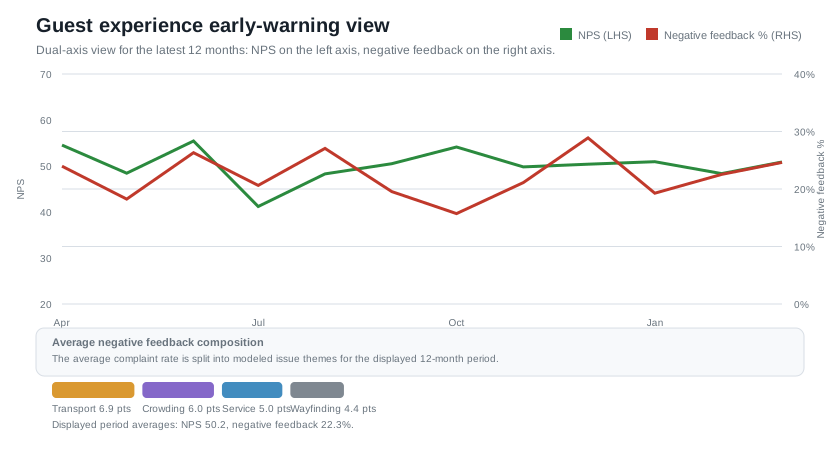
- Guest experience model: NPS starts from a baseline of 50 and negative feedback from 20%, both with modest month-to-month variation and crowding pressure applied in higher-volume months.
- Complaint themes: Negative feedback is split into transport, crowding, service / queueing, and wayfinding / facilities to simulate operational issue tracking.
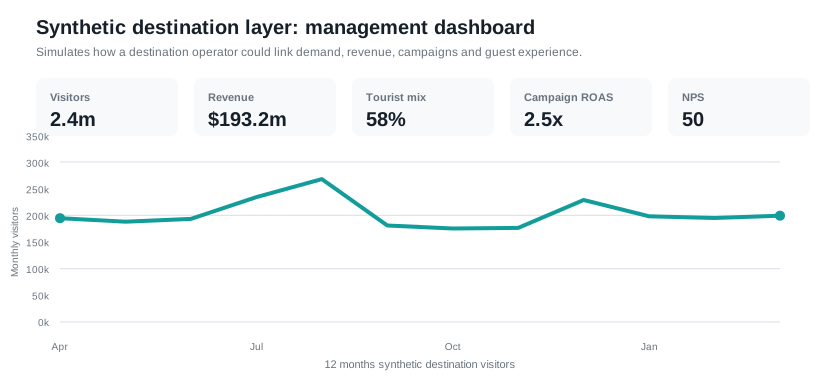
The 12-month dashboard is designed to be easy to audit: visitor volume comes from the public Singapore arrivals base, revenue comes from rounded spend-per-visit assumptions, campaign performance comes from explicit spend and ROAS assumptions, and guest experience is broken into transport, crowding, service/queueing, and wayfinding/facilities themes.
For the modeled 12-month period, the destination captures about 2.4m visits, made up of roughly 1.4m tourist visits and 1.0m local visits. Applying the rounded spend assumptions gives about $193.2m in destination revenue: tourist visits contribute $100 each and local visits $50 each, with that spend allocated across attractions, F&B, retail and events. The same period also produces an aggregate campaign ROAS of about 2.5x and an average NPS of 50, with negative feedback averaging 22%.
SDC Action Table
| Management action | Evidence from analysis | How SDC could use it | Metric to monitor |
|---|---|---|---|
| Prioritize country-specific activation | China, Indonesia, Malaysia, Australia and India account for the largest share of arrivals. | Build source-country views for campaign planning, language localization, travel-trade partnerships and visitor-mix monitoring. | Visitors by source country, campaign ROAS, revenue per visitor |
| Separate volume recovery from value recovery | Hotel room revenue has recovered faster than visitor arrivals. | Track whether destination visitors are converting into higher-yield attraction, F&B, retail and event spend rather than only measuring footfall. | Revenue per visitor, average spend, business-unit revenue mix |
| Use recovery gaps as a growth pipeline | Japan, Germany and Taiwan show positive growth but remain below the 2019 baseline. | Test tactical campaigns, airline/travel-agent partnerships and event bundles for under-recovered but improving countries. | Recovery vs 2019, YoY growth, campaign bookings |
| Protect experience during peak demand | Synthetic guest-experience modeling links high visitorship to crowding and transport complaint pressure. | Pair demand forecasts with transport nudges, crowd-level dashboards, staffing plans and peak-period communication. | NPS, negative feedback %, crowding/transport complaints |
Reproducible Analysis
The full Python pipeline is kept as a separate source file so the portfolio page stays readable while reviewers can still inspect the methodology, data pulls, synthetic data assumptions and calculation logic.
Data Sources
- International Visitor Arrivals by Place of Residence, Monthly
- Monthly Hotel Statistics
- Tourism Receipts by Major Components (Year-to-Date), Quarterly
Note: Singapore tourism demand and hotel benchmarks are official public datasets. Destination revenue, campaign ROAS, guest feedback and local-versus-tourist destination behavior are synthetic and used only to demonstrate analytical approach.